
Why Your Brain Needs Time to Fall in Love: The Science Behind Lasting Relationships
You know that feeling when the butterflies start to fade and you panic, thinking maybe you're not in love anymore? Here's what I want you to know: your brain literally needs 6-12 months to build the foundation for lasting love. That initial rush? It's just your brain's way of getting your attention. The real love develops slowly as your brain builds neural receptors over time. In this article, I'm sharing the science behind why love evolves, what it means when your feelings shift, and how to navigate those crucial first months without second-guessing everything. Download the free Love Evolution Tracker to help you trust the process.
LOVE MYTHS DEBUNKED 💭
3/5/2026
Have you ever felt your heart race at the sight of someone new, only to wonder months later why that initial spark fizzled out? Or maybe you've experienced the opposite - a slow-burning connection that grew into an unshakeable bond?
We've all been there. One moment you're swept up in the intoxicating rush of new romance, and the next you're wondering why everything feels so… different. Less intense. Less magical. And if you're like most people, you've probably asked yourself: Is this still love? Or did I make a mistake?
Here's what I want you to know: your brain needs time to build real, lasting love. Not just a few dates. Not just a few weeks of butterflies and late-night conversations. Actual time - measured in months, not moments.
This isn't your typical romance story. This is the fascinating science of how love actually develops in your brain, why that initial spark is designed to fade, and what it means when it does.
The Illusion of Instant Love
We've all been sold the story of love at first sight - that magical moment when your eyes meet across a crowded room and boom, you just know.
But here's what no one tells you: that intoxicating rush you feel in the beginning? It's not sustainable. And it was never meant to be.
Think about the last time you watched a romantic comedy. The couple meets, sparks fly, they fall madly in love within days, and by the end credits they're planning forever. We've watched this narrative so many times that we've internalized it as truth. When we don't feel that instant, all-consuming certainty about someone, we wonder if something's wrong. Maybe they're not "the one," we tell ourselves. Maybe I should keep looking.
The entertainment industry has done us a massive disservice. Those butterflies, that can't-eat-can't-sleep feeling, that constant rush of excitement - it's not the foundation of lasting love. It's just the opening act.
That initial attraction is like a fireworks display - spectacular, breathtaking, impossible to look away from. But fireworks are designed to capture your attention, not to last. They burn bright and fast, leaving you in awe for a few precious moments before they fade into darkness.
And when that initial intensity fades in your real-life relationship? You might panic. You might think the magic is gone, that you've fallen out of love, that you made a mistake. But what if I told you that this fading isn't the end of love - it's actually the beginning of something deeper?
What's Really Happening in Your Brain
Let me tell you something that might surprise you: love isn't just some magical, inexplicable feeling that defies logic. Love is chemistry. Literal chemistry happening in your brain right now.
When you first meet someone you're attracted to, your brain essentially throws a party. It starts releasing a cocktail of chemicals called neurotransmitters - think of them as your brain's messaging system. These are the chemicals responsible for everything you feel when you're falling in love:
The excitement that makes your hands shake
The butterflies that swirl in your stomach
That slight nervousness that makes you rehearse what you'll say before you text them
The obsessive phone checking, hoping for their message
Replaying conversations in your mind, analyzing every word, every glance
Sound familiar?
This is dopamine at work. Dopamine is your brain's reward chemical, and when it floods your system, you feel euphoric. Everything about this person seems perfect. Their laugh is adorable. Their quirks are charming. Even the way they chew their food seems endearing.
Here's what's happening: your brain is essentially giving you a natural high. It's the same reward system that lights up when you eat your favorite food or accomplish something you've been working toward. Your brain is saying, "This feels good! Let's do more of this!"
But - and this is crucial - your brain cannot maintain this level of intensity indefinitely.
Think about it this way: if you ate your favorite meal three times a day, every single day, for months on end, eventually it would stop tasting as special. Your taste buds would adapt. The excitement would fade. This isn't because the food got worse - it's because your body is designed to regulate itself, to return to balance.
The same thing happens with love's initial chemical rush. Your brain simply cannot sustain that level of dopamine production long-term. It would be exhausting. You wouldn't be able to focus on work, maintain friendships, or take care of yourself. You'd be consumed by this one person, unable to think about anything else.
And that's not love - that's obsession.
So your brain, in its wisdom, begins to adjust. The initial fireworks start to settle. And this is exactly when many people panic, thinking the love is dying. But what's actually happening is that your brain is making room for something much more profound to develop.

The Science of Receptors - Your Brain's "Love Catchers"
Now, here's where it gets really fascinating. Remember those neurotransmitters we talked about - the love chemicals flooding your brain? Well, they can't do their job alone. They need something to catch them. And that's where receptors come in.
Think of receptors as tiny catching mitts in your brain. When your brain releases those love chemicals, these receptors are there to receive them. They're the ones that actually allow you to feel the love, to process it, to integrate it into your experience.
But when you first start falling in love, your brain doesn't have enough receptors built yet to handle the massive amount of love chemicals being released. It's like trying to catch a rainstorm with just a few small cups. Some of the rain gets caught, but most of it just flows past you.
Your brain recognizes this imbalance. It's brilliant, really. It starts saying, "Whoa, there's a lot of love happening here. I need to build more catchers to handle all of this."
And so it begins the process of creating more receptors. But - and this is the key point - this process takes time.
You can't rush the development of neural receptors any more than you can rush the growth of a plant. You can't force it, speed it up, or skip ahead. Your brain needs actual time to build these structures, to strengthen these pathways, to create the infrastructure that allows deep, lasting love to take root.
Research suggests that it typically takes about six months to a year for love to reach what scientists call a "high threshold." This is the point where a person feels deeply committed to the relationship, where they can't imagine their life without their partner, where the bond feels solid and unshakeable.
Six months to a year. Not two weeks. Not one magical night. Not even three months of intense connection.
And here's what's beautiful about this process: as these receptors develop, your experience of love actually changes. That initial nervous excitement starts to transform into something deeper and more peaceful. You might find that you're less anxious around your partner, more comfortable being fully yourself. The relationship stops feeling like a thrilling roller coaster and starts feeling like coming home.
This doesn't mean the love is becoming less - it means it's becoming more.
You're moving from infatuation into genuine intimacy. From chemical rush into emotional safety. From wondering if they'll text you back to knowing, deep in your bones, that they're with you. Not because of excitement, but because of choice. Because of commitment. Because of love that has had time to root itself deeply into the soil of your shared experiences.
This is why a relationship that's six months old feels fundamentally different from one that just started. It's not that the passion is gone - it's that it's evolved. The love has had time to build the neural architecture it needs to sustain itself long-term.
Time Alone Isn't Enough - Quality Matters
Now, before you think I'm saying "just wait it out and love will magically deepen," let me be very clear: time is necessary, but it's not sufficient.
You can spend years with someone and never develop that deep, committed love. Time passing doesn't automatically create intimacy. What makes the difference is the quality of experiences and interactions during that time.
Your brain doesn't just need time to build those receptors we talked about. It needs positive input to build them. Think of it like building muscle. You can't build strength just by waiting - you need to actually use your muscles, challenge them, nourish them. Time alone doesn't create strength. Time plus the right actions creates strength.
The same is true for love. Those receptors in your brain develop in response to positive experiences with your partner:
Every meaningful conversation
Every moment of vulnerability that's met with compassion
Every time you face a challenge together and come out stronger
Every laugh, every shared silence, every moment of truly seeing and being seen
These are the building blocks of lasting love. (For a deeper exploration of what creates strong relationship foundations, see The Three Pillars of Lasting Relationships: Building Deeper Connections Through Trust, Respect, and Dialogue.)
This is why you can't force love to develop just by staying in a relationship. If those months together are filled with constant conflict, emotional unavailability, or feeling unseen and unheard, your brain isn't getting the positive input it needs to build deep attachment. Time is passing, but love isn't growing.
On the other hand, this explains why sometimes a relationship feels solid faster than expected. If the early months are filled with genuine connection, emotional safety, open communication, and shared positive experiences, love can develop more quickly and deeply.
When the Feeling Changes
Here's something else that's important to understand: it's completely normal for the feeling of love to change over time. And this change isn't always a red flag.
When that initial excitement starts to fade - when you're not constantly thinking about them, when seeing their name on your phone doesn't make your heart race anymore, when the relationship starts to feel comfortable instead of thrilling - many people panic. They think, "Oh no, I'm falling out of love. This must not be right."
But what if that shift is actually a sign that you're moving into a deeper, more stable phase of love? What if your brain has built enough receptors that love no longer needs to scream for your attention because it's become woven into the fabric of your daily life?
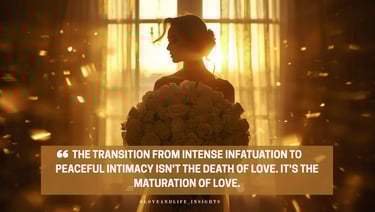
The transition from intense infatuation to peaceful intimacy isn't the death of love. It's the maturation of love. (If you're experiencing this shift and feeling uncertain, When He No Longer Loves You: Your Path to Healing and Self-Discovery offers guidance on distinguishing between natural evolution and genuine disconnection.)
Think about it: do you want to spend the rest of your life feeling anxious and obsessive? Or do you want to build something that feels secure, stable, and deeply nourishing? The nervous excitement is fun for a while, but it's the calm, steady love that sustains us through a lifetime.
So when you feel that shift happening, instead of panicking, pause. Ask yourself: Am I less in love, or am I just less anxious? Has the passion evolved into something quieter but more profound?
This understanding of how love develops over time is crucial whether you're in a new relationship or building toward marriage.
Your Roadmap Through the Next 6-12 Months
Now that you understand the science, here's the challenge: how do you actually navigate those crucial first 6-12 months without panicking when the feelings shift?
How do you tell the difference between healthy evolution and genuine red flags? How do you stay grounded at month 3 when the butterflies fade and your anxious brain screams, "This isn't right anymore!"?
This is where most people stumble. They know intellectually that love takes time, but when they're living through the shifts month by month, doubt creeps in. They second-guess. They bail out prematurely. They mistake the maturation of love for its death.
I created something to help you through this exact journey.
Introducing: Your 6-Month Love Evolution Tracker
This isn't just another journal. It's a science-based guide that walks you through the natural progression of love, month by month, with check-in questions designed to help you:
Track how your feelings evolve from Month 1's chemical rush to Month 6's peaceful intimacy
Distinguish between healthy shifts and genuine red flags at every stage
Document positive experiences that feed your brain the input it needs to build lasting attachment
Stay grounded during panic moments with science reminders about what your brain is doing
Reflect on whether time is revealing depth or incompatibility
The tracker includes monthly check-ins for Months 1, 2, 3, 4, 6, and 9 - the critical turning points where most people either deepen their commitment or walk away prematurely.
It's designed to help you trust the process when your anxious mind wants to rush to conclusions.
Download your free Love Evolution Tracker here → [Link to download]
Because understanding the science is one thing. Having a tool to apply it during the messy, uncertain middle months? That's everything.
Closing
Love is a journey, my dear friend. And like any meaningful journey, it cannot be rushed.
Your brain needs time to build the infrastructure that allows lasting love to flourish. Those receptors don't develop overnight. That deep sense of commitment and security doesn't arrive in a flash of lightning. It grows slowly, steadily, fed by positive experiences and genuine connection.
But here's what I want you to remember: while love needs time, it also needs intention. It needs presence. It needs you to show up, to be vulnerable, to choose connection even when it feels easier to protect yourself.
The science of love doesn't diminish its magic - it deepens our understanding of it. When you know that your brain is literally rewiring itself to hold this person, when you understand that the calm you feel isn't boredom but security, when you recognize that love's evolution is natural and necessary, you can approach your relationships with more patience, more compassion, and more wisdom.
So be gentle with yourself. Be patient with the process. Trust that if you're creating positive experiences, if you're building genuine intimacy, if you're choosing each other day after day, your brain is doing the beautiful work of building something that can last.
The initial spark might be what catches your attention, but it's the slow-burning flame - tended carefully over months and years - that keeps you warm for a lifetime.
This is KC - from Love & Life. ✨
You now understand the science. But knowing isn't the same as navigating it - especially when doubt creeps in at month 3 and your mind starts whispering "maybe this isn't right anymore."
That's exactly why the Love & Life Resource Library exists - with tools like the Love Evolution Tracker, attachment style guides, and relationship check-ins to help you trust the process at every stage.
Access the Free Resource Library →
✨ Your brain is doing the work. Let these tools help you stay grounded while it does.