Why Giving Everything Away Doesn't Make Him Love You More
We were taught that sacrifice is how you prove love. That giving more, enduring more, asking for less — that's what devotion looks like. But there's a truth underneath that belief that nobody talks about. And it's costing women more than they realize.
LOVE MYTHS DEBUNKED 💭
1/18/2026
We were taught that sacrifice is how you prove love. That giving more, enduring more, asking for less — that's what devotion looks like. But there's a truth underneath that belief that nobody talks about. And it's costing women more than they realize.
There's a belief so deeply embedded in how women are taught to love that most of us have never thought to question it:
If I give enough, he'll finally value me the way I need to be valued.
It doesn't announce itself as a belief. It announces itself as love. As patience. As being the kind of woman who doesn't ask for much, who doesn't make things difficult, who keeps showing up even when it's hard.
But underneath all of that is a quiet transaction — an exhausting, one-sided hope that if you sacrifice enough, if you endure enough, if you make yourself small enough, the devotion you're pouring out will eventually come back to you.
I want to talk about what actually happens instead.
What Sacrifice Teaches Him
When you consistently put his needs above yours — your time, your wants, your boundaries, your comfort — you're not just being generous. You're teaching him something.
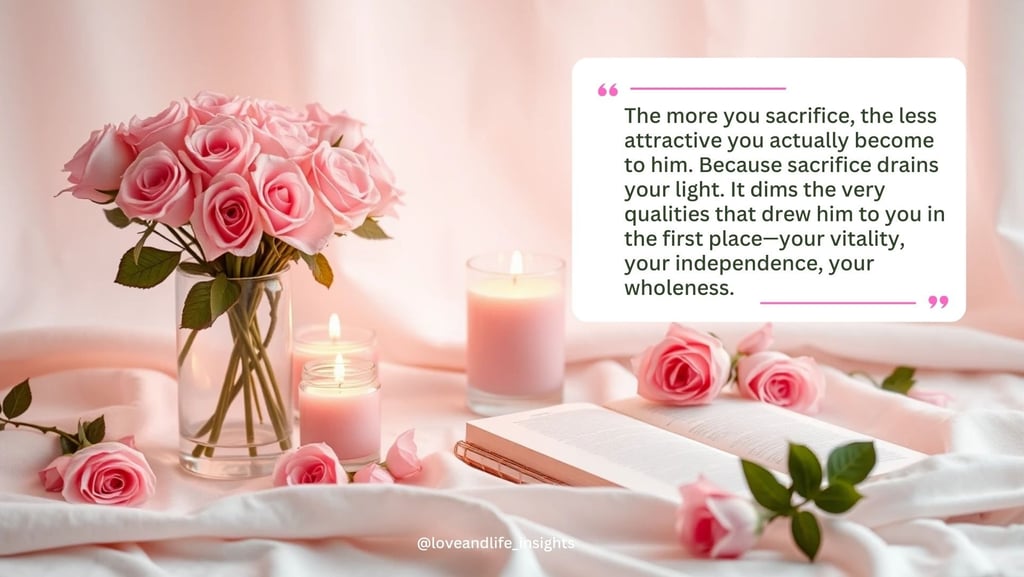
You're teaching him that your needs are negotiable. That your time is always available. That there are no real consequences for not considering you, because you'll consider yourself last anyway.
This doesn't happen because he's calculating or cruel. It happens because people normalize what they're shown is normal. When you consistently signal that your own wellbeing is secondary to his comfort, he stops seeing your sacrifices as something exceptional. They become the baseline. The expected. Just how things are.
And then — this is the part that stings most — when you start taking up a little more space, when you finally say no to something or ask for something back, he experiences it as a shift. Something changed. You became more demanding. More difficult. Less easy to be with.
You've heard it said out loud, probably. "You've changed."
As if the depleted version of you who gave everything away was the real you. As if the woman who finally decided she mattered was the imposter.
The Difference Between Giving and Losing Yourself
I want to be careful here, because this isn't an argument against generosity. Healthy relationships involve real giving — choosing to put someone else first sometimes, showing up in ways that cost you something, the ordinary daily work of caring for someone.
But there's a distinction worth holding:
Giving comes from fullness. You have something and you choose to share it. It feels good because it comes from a place of abundance — your joy, your energy, your love overflowing and finding somewhere to go.
Sacrifice comes from depletion. You're already running low and you give anyway, hoping the act of giving will somehow fill you back up. It doesn't feel good from the inside — it feels like an offering you're making to a relationship you're afraid of losing. Like you're trying to earn your place.
The difference isn't visible from the outside. Both look like love. But only one of them is sustainable. And only one of them tends to be met with the kind of appreciation and reciprocation you're hoping for.
Because here's the thing about exhausted, self-erasing giving: it doesn't read as devotion. It reads as someone who doesn't know her own value. And people — even people who care about us — tend not to treasure what we haven't taught them to treasure.
What You're Actually Hoping For
The sacrifice pattern almost always has the same shape underneath it: if I give enough, he'll finally see what I'm worth.
I understand that hope. I've lived inside it.
But your worth isn't something he discovers by watching you give. It's something you demonstrate through how you hold yourself — what you accept and what you don't, what you ask for and what you're willing to walk away from when it's not given.
A man who genuinely values you doesn't need you to sacrifice yourself to understand your value. He can see it. And the version of you who's given everything away, who's lost herself in managing his comfort and happiness, who's forgotten what she wanted before this relationship consumed her attention — that version is actually harder to see clearly. There's less of her to see.
The women I've watched build genuinely reciprocal relationships weren't the ones who gave the most. They were the ones who stayed most fully themselves. Who had lives that mattered to them outside the relationship. Who made it clear, not through words but through how they moved, that their time and attention were things worth showing up for — not things that were simply available by default.
What Changes When You Stop
When you stop sacrificing and start giving from fullness instead, a few things happen.
First, you find out what's actually there. When you stop filling every space with your effort, you see whether he fills any of it himself. Some men do. That's real, and it's worth knowing. Others don't — and that's real too, and also worth knowing, even if it's harder to see.
Second, you get yourself back. The passions that got quieter. The friendships that thinned out. The version of you that had her own energy and her own direction before this relationship became the primary thing you were managing. She didn't disappear — she just got sidelined. She's still there.
And third — this one takes time — you stop needing the sacrifice to work. Not because you care less, but because you've remembered that your value doesn't depend on whether he recognizes it. It was always there. It's not something he gives you by finally seeing it.
You are not here to earn your place in someone's life. You never were.
—
This is KC — from Love & Life. 💜
If the pattern of giving too much and receiving too little is something you keep finding yourself in — not just with him, but as a recurring shape in your relationships — the free guide covers the attachment patterns underneath it. That's usually where the real answer lives.