When Love Isn't Enough: Understanding Why You Feel Sad, Tired, and Lonely After Taking Him Back
You took him back after the betrayal because you loved him deeply. He seems to care, he's attentive - yet you feel constantly sad, tired, and profoundly lonely. What's wrong with you? Nothing. Your emotions are wise messengers trying to tell you a truth you might not be ready to hear: you're holding onto something that can no longer be whole. In this deep dive, we decode what your heart is really saying, why his care isn't the love you deserve, and why letting go is the bravest act of self-love you can choose. If you've ever wondered why reconciliation feels so hollow, this is your answer.
HEALING & GROWTH 🌱LOVE & LIFE Q&A 💬
11/26/2025


Have you ever taken someone back after they betrayed you, only to find yourself drowning in feelings you can't quite name?
A reader recently shared with me: "After discovering my partner's infidelity, we broke up, but I took him back because of my deep love. Despite his seemingly unchanged care and attention, I constantly feel sad, tired, and lonely."
My dear friend, if you're reading this and nodding along, I want you to know something important: these emotions aren't random, and they're not a sign that something is wrong with you. They're actually wise messengers from your heart, trying to tell you a truth you might not be ready to hear.
Today, we're going to explore what each of these feelings - sadness, tiredness, and loneliness - is really trying to communicate. Because when you understand the language of your heart, you can finally make the decision that sets you free.
Let's decode these signals together.

The Weight of Sadness
The persistent sadness you're feeling isn't just about missing what you had - it's about mourning what can never be restored.
You're continuing with someone who has fundamentally broken your trust. Even if he seems to care for you more now, even if he's attentive and present, there's a part of you that can never fully relax into his love again. Because somewhere deep inside, there's always that whisper: "Will he deceive me again?"
This sadness is your heart grieving the loss of something beautiful and irreplaceable: the wholeness that once existed between you two. That sense of complete safety, of unwavering trust, of knowing without question that you were cherished - it's fractured now. And no amount of his renewed attention can repair what was shattered the moment he chose someone else.
You're sad because you're trying to hold onto a relationship that, deep down, you know is no longer whole.


The Exhaustion of Emotional Dependency
Now, the tiredness you're experiencing - this isn't the normal fatigue of a busy life. This is bone-deep exhaustion, the kind that sleep can't fix.
You're absolutely drained because you're forcing yourself to accept someone who has deceived you. You might believe you took him back purely because you love him so much, but there's a deeper, more painful truth at work here: emotional dependency.
This means you're not quite strong enough yet to let go. And this very dependency - this clinging to something you know, intellectually, you shouldn't accept - is what's draining your vital energy from within.
Think about it: your mind knows this relationship is damaged. Your intuition is sending you warning signals. But you're overriding all of that, pushing against your own inner wisdom, trying to convince yourself it's okay. That internal battle? That's what's making you so profoundly tired.
You're exhausted because you're fighting against your own truth.
The Ache of Loneliness
And then there's the loneliness - perhaps the most painful feeling of all because it's so confusing. How can you feel alone when you're with someone?
This loneliness exists because the connection between you two is fundamentally broken. Though things may look fine on the surface - you're still together, he still cares for you - inside, there's a constant strain. The spontaneous joy is gone. The deep, authentic connection you once shared has been replaced by something that feels hollow.
You can't be truly vulnerable with him anymore because trust is the foundation of vulnerability. You can't share your deepest fears or your brightest dreams with the same openness, because part of you is always guarding, always protecting, always waiting for the next hurt.
You feel lonely within your own relationship because the two of you can no longer truly connect on that deeper, authentic level like before. You're together, but you're each isolated on your own islands, unable to bridge the gap that his betrayal created.
The Rotten Apple Truth
Now you understand why you feel sad, tired, and lonely. All these difficult emotions stem from one fundamental reality: you're trying to cling to a relationship that has, for all intents and purposes, spoiled.
It's a relationship that, deep down, you know is no longer whole or truly capable of bringing you happiness. But even though you know this, you might not feel strong enough to let go - so now you're enduring these heavy, negative emotions.
Let me give you an image that might help this truth sink in.
The Rotten Apple
Imagine I threw away a rotten apple. But then, moments later, I felt a pang of regret. So I picked it back up, dusted it off, and took a bite. After eating it, I might think, "Well, it's edible... but why does it taste and smell so strange?"
Wouldn't you immediately say, "That's right, KC! You're eating a rotten apple that you already threw away. If it's rotten by nature, of course it will taste and smell off!"
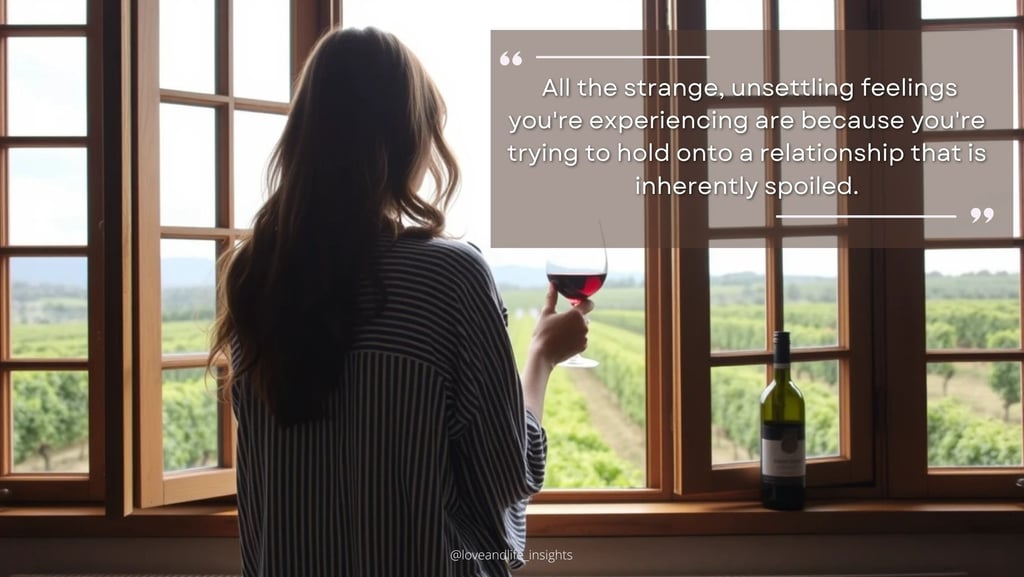
Do you see it now, my friend? All the strange, unsettling feelings you're experiencing are because you're trying to hold onto a relationship that is inherently spoiled.
He lost feelings for you. He found someone else. He chose to betray your trust. How can he come back and truly love you now, making everything as good as before?
I'm so sorry to say this, and I know it might hurt to hear it so plainly, but I need to help you see this truth clearly for your own healing: that will never happen.
His Care Isn't Love - It's Guilt
Your current relationship is fundamentally damaged and cannot be restored to its original state. That's not pessimism; that's simply the nature of broken trust.
He might care for you a bit more now, he might be more attentive, but it doesn't stem from genuine, deep feelings of love. It comes from guilt. It comes from obligation. It comes from the discomfort of being the one who caused pain.
You can verify what I'm saying by observing him over time. Watch if he gradually becomes indifferent again. Notice if his care feels performative rather than natural. Pay attention to whether his actions come from his heart or from his sense of duty.
Because here's what's really happening: he's also forcing himself to maintain this relationship. Everything he does might simply be out of guilt or because he doesn't want to be the "bad guy" twice. He's staying - not because his heart is fully in it, but because leaving again would confirm what he already knows about himself.
You're both trapped in a relationship held together by fear, guilt, and dependency - not by genuine love.


Why Walking Away Is Your Best Path Forward
So what do you need to do right now, my dear? The answer is simple to say but incredibly brave to do: stop completely with him and return fully to your own beautiful life.
The Core Issue You Must Face
Here's the truth you need to accept: he no longer truly loves you in the way you deserve. This relationship, in its current form, is beyond repair.
He's not breaking up with you - but not because he's deeply in love. He's staying because he feels guilty. Because he feels responsible. Because breaking up again would make him feel like a terrible person. Because it's easier to stay in the familiar than to face the discomfort of leaving.
He's staying for all those reasons - but not because his heart is fully, authentically, passionately invested in building a beautiful future with you.
The Gift of Distance
Therefore, the best way forward - the kindest thing you can do for yourself - is to create distance from him to find true peace for yourself.
I know this sounds impossibly hard right now. I know that when you're emotionally dependent on someone, the thought of letting go feels like losing a part of yourself. Breaking up doesn't just mean losing him; it feels like losing your sense of security, your hope for the future, your belief that love can work out.
And I want you to know: it's okay that this is difficult. The difficulty doesn't mean you're weak or foolish. It means you're human, and you loved deeply, and letting go of someone you love is one of the hardest things anyone can do.
What Staying Costs You
But here's what I need you to understand: staying in this relationship is costing you something precious. It's costing you:
Your peace of mind
Your vital energy
Your self-respect
Your ability to trust yourself
Your chance at experiencing real, wholehearted love
Your time - time that could be spent healing and growing
Every day you stay is a day you're choosing familiar pain over the unfamiliar path of healing. And while I understand why you're making that choice - dependency is powerful - I also need to lovingly challenge you to consider what you're sacrificing.
You deserve more than a relationship held together by guilt and fear. You deserve more than surface-level care from someone whose heart isn't truly in it. You deserve the kind of love that doesn't leave you feeling sad, tired, and lonely.
And that love? It will never come from this man, in this relationship, as it exists now.
The Deeper Lesson - Learning to Date Correctly
After everything we've discussed, here's the most important question you need to gently ask yourself: "Why did someone who once loved me lose their feelings to the point of seeking out someone else?"
This isn't about blaming yourself for his betrayal - his choice to cheat was his responsibility alone. But understanding what created the conditions for disconnection? That's wisdom you need for your own future.
The Two Fundamental Mistakes
The reasons relationships fall apart often come from two core issues:
First, your relationship didn't start the right way.
Perhaps you moved too quickly into commitment before truly knowing each other. Perhaps you overlooked red flags because you were swept up in the intensity of new love. Perhaps you didn't establish clear boundaries and expectations from the beginning. Maybe the foundation was built on attraction and excitement rather than genuine compatibility and shared values.
When a relationship doesn't start on solid ground, it's vulnerable to crumbling under pressure - and his ability to betray you suggests that foundation was never as strong as you believed.
Second, you may not know how to truly build and sustain deep feelings in a lasting way.
This isn't about being unlovable or doing something wrong. It's about whether you understand the daily practices, communication patterns, and emotional intelligence required to keep love alive and growing. Do you know how to maintain mystery while building intimacy? How to give without losing yourself? How to communicate needs without creating resentment? How to navigate conflict in ways that bring you closer rather than drive you apart?
These are skills, my love. And most of us were never taught them.
4 Mistakes That Push Men Away (And How to Fix Them)
When He's Two-Timing: Your Path to Clarity and Healing
The Pattern You Must Break
Here's what concerns me: when you choose to get back with someone who has deceived you, it suggests that your current version - your thoughts, your values, your way of solving problems in relationships - might have some underlying issues that need nurturing.
I say this not to criticize, but to help you realize: there's a high chance you're making mistakes in relationships without even knowing it. And that's the truly dangerous part - because you can't fix what you don't see.
If you're lucky enough to finally let go of this man, but you still don't know how to date correctly, you'll likely repeat the same painful patterns with someone else. It's like changing the deck of cards but playing with the same old strategies - you'll still lose the game.



The Invitation to Transform
So I want you to think deeply about this, my friend. Reflect on your dating patterns:
Do you tend to ignore red flags early on?
Do you lose yourself trying to keep someone's interest?
Do you accept less than you deserve because you're afraid of being alone?
Do you know how to build genuine emotional connection, or do you rely on physical intimacy to create a false sense of closeness?
Can you maintain your own life, interests, and boundaries while building a relationship?
The good news? Once you see these patterns clearly, you can change them. Once you learn to date correctly - to choose wisely, to build slowly, to communicate authentically, to maintain your worth - everything transforms.
Your next relationship doesn't have to repeat this painful story. But only if you're willing to do the inner work now, while you're healing, to become the version of yourself who naturally attracts and sustains healthy love.
3 Actions You Can Take Today
If you're ready to begin your journey toward healing and transformation, here are three concrete steps you can take right now:
1. Write a Letter You'll Never Send
Sit down with a journal and write everything you wish you could say to him—all the hurt, the anger, the disappointment, the love you still feel, and the truth you're afraid to speak. Don't hold back. This isn't about being fair or kind; it's about releasing what you've been carrying. Once you've poured it all out, you can choose to keep it, burn it, or tear it up. The act of writing itself is what begins to set you free.
2. Create a "Pattern Recognition" List
Take out a piece of paper and divide it into two columns. On the left, write "Red Flags I Ignored." On the right, write "What I'll Pay Attention to Next Time." Be brutally honest with yourself about the warning signs you overlooked—not to blame yourself, but to ensure you never ignore them again. This exercise builds the awareness that will protect your heart in future relationships.
3. Establish One Boundary Today
Choose one small way to create emotional distance and reclaim your energy. Maybe it's turning off his notifications. Maybe it's saying no to a date night you don't feel like having. Maybe it's spending time with a friend instead of waiting for his call. Start practicing what it feels like to put yourself first - even in small ways. Each tiny boundary you set is a brick in the foundation of your new, stronger self.
Closing
My dear friend, I know this message has been difficult to hear. Breaking up with someone you love, especially when you're emotionally dependent, is one of the most painful experiences you'll ever go through.
But I also know this: you are so much stronger than you realize. The fact that you're here, reading this, asking these hard questions - that tells me you're already awakening to your own truth.
You deserve a love that doesn't leave you feeling sad, tired, and lonely. You deserve someone whose care comes from genuine devotion, not guilt. You deserve a relationship built on trust so solid that you never have to wonder, "Will he hurt me again?"
And that kind of love? It starts with you choosing yourself - even when it's terrifying, even when it hurts, even when every part of you wants to hold on just a little bit longer.
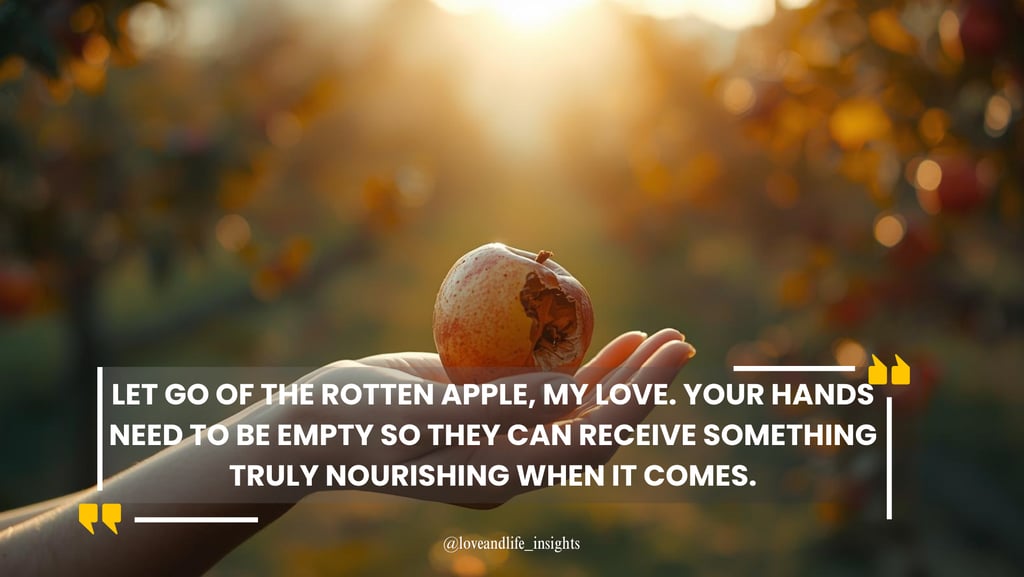
Let go of the rotten apple, my love. Your hands need to be empty so they can receive something truly nourishing when it comes.
This is KC - from Love & Life. ✨