
When Love Feels Like Walking on Eggshells
The hardest part isn't what he's doing. It's that you've started to believe him about who you are. This is for the woman who knows something is wrong but keeps talking herself out of it.
HEART TALK
KC
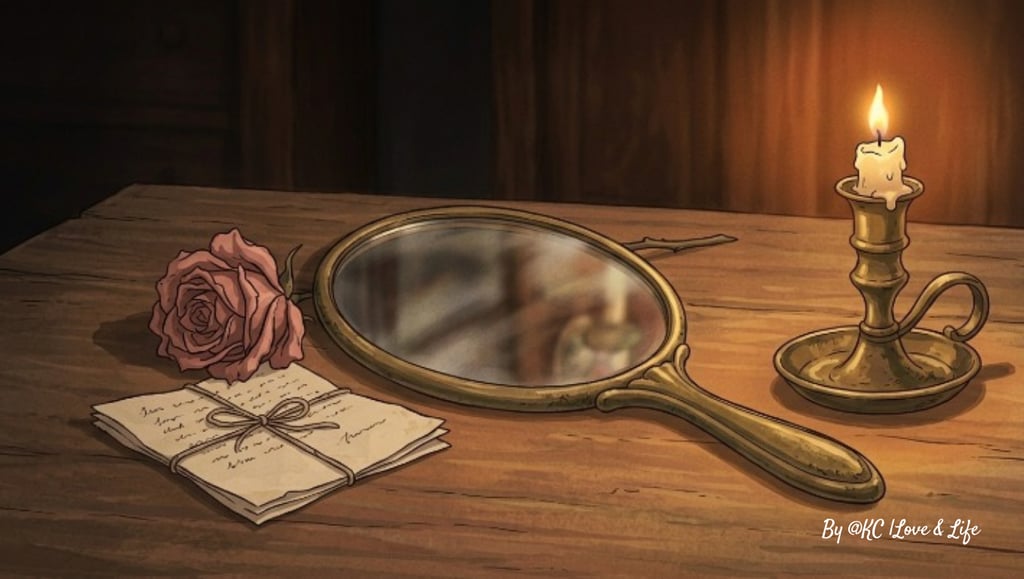

There's a particular kind of exhaustion that doesn't show up on your face.
It lives in the way you pause before you speak. In the split second before you send a text when you reread it one more time, adjusting the tone, softening the edges, trying to anticipate how he'll receive it. In the way you walk into a room and immediately read the atmosphere — is he okay today? What kind of evening is this going to be?
You're not tired from doing too much.
You're tired from being careful. All the time. About everything.
If you recognize that feeling — if you're reading this and something in your chest is quietly saying yes, that's it, that's exactly it — then I want to stay here with you for a while. Because what I'm about to share isn't easy to read. But it's the kind of thing I wish someone had said to me, clearly and without softening it too much, before I lost more of myself than I needed to.

💜 If this landed somewhere real
You don't have to figure out the next step alone. The Free Resource Library includes tools for understanding your patterns, rebuilding your boundaries, and finding your way back to yourself — at whatever pace you need.
What Emotional Exploitation Actually Is
Before anything else, I want to be specific about what we're talking about — because the word "exploitation" sounds dramatic, and dramatic is easy to dismiss.
Emotional exploitation isn't one terrible incident. It's not a moment you can point to and say: there, that's when it happened. It doesn't announce itself. It doesn't arrive with obvious warning signs or a clear before and after.
It arrives as patterns. Small ones, at first. A comment that stings slightly more than it should. A reaction that seems disproportionate but has a reasonable enough explanation. A boundary you expressed that got quietly ignored — and when you brought it up, somehow the conversation became about your tone, your timing, your sensitivity.
Each thing, in isolation, is dismissible. Together, over time, they do something very specific: they make you doubt yourself. Your memory. Your perception. Your right to feel what you feel.
And here's what makes it so hard to name: the person doing this may not be doing it consciously. Some people learned these patterns from their own pain, their own history. Understanding that is real — and it doesn't change what it costs you.
The Signs That Are Easy to Miss
You're always reading the room.
Not because you're intuitive — though you are — but because you've learned that his mood is something you need to manage. You wake up and check. You come home and check. The temperature of the room tells you what kind of evening this will be, and you adjust accordingly.
That's not love. That's hypervigilance. And it's exhausting in a way that's hard to explain to someone who hasn't lived it.
Your gut keeps saying something, but you keep talking it out of it.
You have this persistent feeling that something's wrong — but when you try to name it, you can't. He hasn't done anything obviously terrible. He says he loves you. So you push the feeling down, tell yourself you're being paranoid, remind yourself how much worse things could be.
Here's what I've come to understand: your intuition speaks before your mind can articulate why. That feeling isn't anxiety or overthinking. It's your nervous system tracking patterns that your conscious mind is still making excuses for.
He uses love as a reason to control.
I love you so much I need to know where you are. I care about you, so I need to see your phone. If you really loved me, you wouldn't dress like that.
Notice how every controlling request is wrapped in the language of love and protection. This isn't love — it's possession wearing love's clothes. Real love trusts. Real love doesn't require you to make yourself smaller to make someone else feel secure.
Your reality keeps getting rewritten.
You bring up something hurtful he said. He insists he never said it — or that you misunderstood, or that you're being too sensitive. Over time you find yourself questioning your own memory. Your own perception. Whether you really are as unreasonable as he says.
This is gaslighting. And what it steals from you isn't just your confidence in him — it's your confidence in yourself. In your own ability to know what's real.
The isolation happened so gradually you almost didn't notice.
First it was one friend he didn't like. Then another who was "a bad influence." Your family doesn't understand your relationship. Your coworkers are jealous of what you have. Slowly the circle gets smaller — and with it, the number of people who can offer you perspective from outside the story you're both living inside.
Isolation isn't incidental to emotional exploitation. It's the goal. Because when you have no outside perspective, you have nothing to measure your experience against. You start to accept what's happening as normal — because it's all you can see.
Affection has become currency.
He's warm and attentive when you do what he wants. The moment you disappoint him, assert a boundary, or have a different opinion — the warmth disappears. You find yourself performing, accommodating, shrinking — not because you want to, but because you're afraid of losing his approval.
Love shouldn't feel like something you earn. Affection used as reward and punishment isn't intimacy. It's leverage.
His choices have become your fault.
I only acted that way because you made me so angry. If you hadn't done that, I wouldn't have had to react this way. Look what you made me do.
When someone consistently makes you responsible for their behavior, they're doing two things at once: avoiding accountability for themselves, and training you to believe that if you could just be different enough, none of this would happen.
You can't be different enough. That's not how this works.
You don't recognize yourself anymore.
This is the one that usually arrives last — and hits hardest. You used to be confident. Opinionated. Full of something. You had friends, passions, a sense of yourself that didn't depend on how he was feeling that day.
Now you're not sure where that woman went. You've been making yourself smaller for so long — dimming your light, softening your edges, adjusting your personality to avoid triggering something — that you've lost track of what you actually are when no one's watching.
When a relationship requires you to become less of yourself to sustain it, it is not the right relationship. The right person doesn't need you to shrink. They're glad you take up space.

Why You're Still There
I know what some of you are thinking right now.
But he's not always like this. Sometimes he's wonderful. Sometimes I see the person I fell in love with.
I know. Because that's exactly how this works.
If he were terrible all the time, you'd leave. But he's not. He can be kind, attentive, the person you chose — just often enough to make you believe that that version is the real one, and everything else is circumstantial. Work stress. A hard week. Something you triggered without meaning to.
So you hold onto the good moments. You make excuses for the rest. You tell yourself that if you love him well enough, patiently enough, the good version will eventually stay.
Here's what I need you to understand: the inconsistency isn't a flaw in the pattern. It's the pattern. The warmth is what makes the coldness bearable. The good days are what make you doubt your read on the bad ones. Without them, you'd see clearly. With them, you keep hoping.
That hope isn't weakness. It's what you do when you love someone. But it can also be the thing that keeps you in a place that's slowly costing you everything.
What This Is Actually About
All of these patterns — the eggshells, the rewritten reality, the shrinking, the isolation — they serve the same purpose.
To keep you off-balance. Uncertain. Dependent on his version of events because you've stopped trusting your own.
That's not love. Love doesn't require you to doubt yourself to sustain it. Love doesn't grow in an environment where one person's emotional state controls the entire atmosphere. Love doesn't ask you to become less so someone else can feel like more.
I'm not telling you what to do with this. That's yours to decide — and it may not be simple, and it may not be fast, and I won't pretend otherwise.
But I am asking you to stop talking yourself out of what you already know.
Your intuition brought you here. It's been trying to tell you something for a while now.
It's not wrong.
This is KC — from Love & Life. 💜