
Two Men, Two Kinds of Love
I read Kane and Abel for the first time during a summer back home — five hundred pages, then immediately read it again. I've been thinking about it ever since. Not because of the ambition or the rivalry. Because of how those two men loved.
WHAT I'M READING
4/19/20263 min read
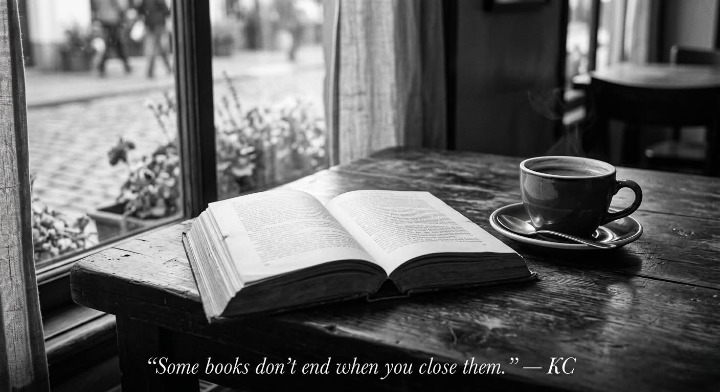

I found a quiet corner of Bangkok recently — a small café that also seemed to be a hotel, the kind of place where people come to slow down. I had a book. I had time. And somewhere between the coffee and the stillness, I found myself thinking about two men I first met during a summer back home, when the days were long and unhurried and I needed stories that went very large.
Kane and Abel. Jeffrey Archer. 1979. Five hundred pages, and I read it twice — the second time starting almost before I'd finished the first.
I don't reread books lightly. But this one did something to me that I'm still trying to put into words.
The two kinds of strength
William Lowell Kane is the strength of order. Born at the top, he moves through the world with the precision of someone who has always understood the rules — and decided, early, that losing was not an option. Cold on the surface. Deeply feeling underneath. The kind of man who loves quietly and keeps his word absolutely.
Abel Rosnovski is something else entirely. He comes from nothing — from the very bottom of poverty and war and survival — so every choice he makes carries the weight of a man who knows what it costs to lose everything. Where Kane controls the world, Abel fights it. Every single day of his life.
Two kinds of strength. Both absolute. Neither one soft.
And yet — what I keep returning to, what I find myself thinking about in quiet cafés on weekend afternoons — is not their ambition. It's how they loved.
What stayed with me
I have favorite characters the way some people have favorite places — I return to them when I need to remember something about myself. Scarlett O'Hara and Melanie Hamilton have been with me for years: two women, two kinds of strength, neither one complete without the other. I never expected to find their male counterparts in a Jeffrey Archer novel from 1979. But that's exactly what happened.
Kane loved one woman, essentially, for his entire life. No drama. No spectacle. His love was consistent and contained, like a commitment rather than a feeling — the same way he ran his company, the same way he held his principles. Kate Brooks was his anchor. The place he could be quiet in.
Abel loved differently. More wildly. More painfully. His greatest love was his daughter Florentyna — a love that carried guilt and grief and redemption all at once. If Kane loved like a man keeping a vow, Abel loved like a man trying to live the life that was taken from him. Both kinds of love were total. Neither one left room for anything less.
I think about that a lot. The idea that real love — whichever form it takes — doesn't divide your attention. It deepens it.
The thing Archer understood
What makes this novel stay with you is not the rivalry between these two men. It's that they spent their entire lives as enemies — and somehow, without meaning to, kept saving each other. Every time one of them rose, the other had to become stronger. Every obstacle one created for the other pushed that person further than they would have gone alone.
They were never on the same side. And yet together, they built something.
Archer's answer to why America became great is not resources or history. It's this: because it made room for both Kane and Abel. One who preserved order. One who broke limits. One who inherited a legacy. One who built one from nothing. When those two kinds of people exist in the same place — even in opposition — they write history together.
I've been sitting with that idea for days now.
Some books don't end when you close them.
This is KC — from Love & Life. 💜
P/S — I'm writing this on April 18th. Which happens to be the birthday of both William Kane and Abel Rosnovski. I didn't plan it that way. Some coincidences are too quiet to ignore.