
Tomorrow Is Another Day
I watched the film first, then read the novel. When I finally closed the book, it stayed with me for years — not because of the love story, but because of one woman who refused to be pitied, even at her lowest. Scarlett O'Hara is not a role model. She's something more honest than that.
WHAT I'M READING
5/2/20264 min read

I came to Gone with the Wind the way many people do — film first, then the novel. I was young. I watched Scarlett O'Hara move through ballrooms and battlefields and heartbreak, and I thought I understood her.
It took reading the book to realize I'd only seen the surface.
When I finally closed those pages, something had shifted. Not dramatically — quietly, the way the important things usually do. I've returned to Scarlett more times than I can count since then. Not always by rereading. Sometimes just by remembering her in the middle of an ordinary day, when life asks something difficult of me and I need to remember what it looks like to refuse to collapse.
Two women, one novel
What Margaret Mitchell understood — and what makes this novel survive — is that strength is not one thing.
Scarlett O'Hara is will. Raw, unapologetic, sometimes ugly will. She is vain and calculating and capable of genuine cruelty. She marries three times, never once for love. She lies without much guilt. She takes what she needs to survive and doesn't spend a great deal of time apologizing for it. In the world she inhabits — a world of rigid propriety and devastating war — she bends every rule she was raised to keep.
And yet.
She hails cotton. She walks miles for food. She holds an entire household together through a war that destroys everything she was born into. From a girl who had never done anything more difficult than choose a dress for a party, she becomes someone who simply does what needs to be done. Not gracefully. Not cheerfully. But absolutely.
Melanie Hamilton is the other kind of strength — and Mitchell is too good a writer to make her merely Scarlett's foil. Melanie is gentle where Scarlett is sharp, patient where Scarlett burns. But she is not weak. Not even close. She has a moral clarity that Scarlett never quite manages, and a loyalty so complete it functions almost like armor. In the most dangerous moments — and there are several — it is Melanie, quietly and without drama, who holds the line.
I've loved both of them for a long time. Two women, two kinds of strength, neither one the whole picture on her own.
The scene I can't forget
There is a moment near the end that I think about more than any other.
Scarlett has finally understood — too late, as these things usually go — that what she felt for Ashley Wilkes was never love. It was obsession. It was wanting something precisely because it seemed out of reach, the way a child cries for the moon without knowing what they'd do with it if they actually had it.
And in the same moment she understands this, she understands something else: that Rhett Butler — difficult, unpredictable, the man she kept at arm's length even as he loved her — was the one who actually saw her. All of her. The beauty and the ruthlessness and the fear underneath both. He loved her anyway. Not despite her real self, but because of it.
She runs home through the fog. She tells him. She is ready, finally, to be honest.
And he says: My love for you is dead.
I remember reading that scene and sitting very still afterward. Because life does this. It waits until you've paid the full price of a lesson before it lets you learn it. By the time Rhett was brave enough to say what he felt, loving her had cost him too much. And by the time Scarlett was brave enough to receive it, it was already gone.
What breaks your heart is not the ending. It's the timing.
What she does next
Here is the part that stayed with me longest.
In her most desperate moment — rejected, alone, everything she wanted finally clear to her and completely out of reach — Scarlett makes a decision. She will not let him see her break. Not because she doesn't feel it. But because she refuses to be pitied by the one person whose respect she actually wants.
I can't let him despise me. He has to respect me, even if he no longer loves me.
She straightens. She leaves. She goes home to Tara — to the land that has always been her anchor, the one thing that never abandoned her — and she makes herself think.
Not tonight. Tomorrow.
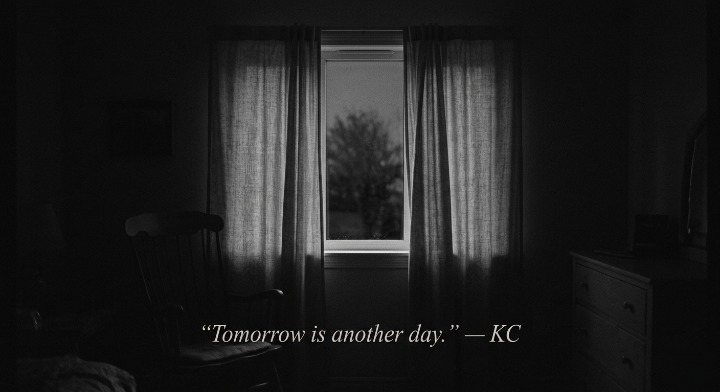
After all, tomorrow is another day.
I have thought about that line in hospital rooms. In the particular silence after something ends. In the moments when I didn't know what came next and couldn't quite face figuring it out yet.
It's not optimism, exactly. It's something more practical. A decision to still be standing when morning comes. To not give the worst moment the power to be the last word.
Why Rhett loved her
I used to wonder about this. Rhett Butler is charming and perceptive and could have had almost anyone. Why Scarlett — difficult, self-absorbed, frequently infuriating Scarlett?
I think I understand it now.
Because she lived her own life. Completely. She took her own joy and her own grief as her own business, answerable to no one. She didn't perform contentment she didn't feel. She didn't shrink herself to make others comfortable. When she was knocked down — and she was knocked down, repeatedly and hard — she got back up without asking anyone's permission or waiting for anyone's encouragement.
She didn't need to be rescued. She needed to be matched.
There is something in that which speaks to something real. Not the selfishness — I'm not recommending that. But the part about living your own life. Knowing your own mind. Not outsourcing your self-respect to whether or not someone chooses you.
The women who ask me: how do I make him come back, how do I make him regret it, how do I know if he's thinking of someone else — I understand why they're asking. I've been in versions of that question myself.
But Scarlett never asked those questions. Not because she didn't feel the loss. Because she understood, somewhere underneath everything, that her life belonged to her. That the only person she absolutely could not afford to lose was herself.
Tomorrow is another day.
She said it at her lowest. She meant it absolutely.
This is KC — from Love & Life. 💜
P/S — The two notes I wrote about this book were written years apart. One during the pandemic, when I first read Kane and Abel and found myself thinking about Scarlett again. One earlier, when I was still figuring out what I believed about love. Reading them back to back, I realized I've been in conversation with these characters for most of my adult life. Some books are like that. They grow with you.