The Version of You That Heartbreak Builds
There's what heartbreak takes from you — and then there's what it quietly builds, if you let it. Not in the "everything happens for a reason" way. In the real way. Here's what I learned when I stopped trying to survive it and started paying attention to what it was teaching me.
HEART TALKSELF-WORTH AND GROWTHBREAKUP AND LETTING GO
KC
4/18/2026
I still remember what that winter felt like.
Everyone around me was celebrating — the holidays, the new year, the fresh start everyone talks about in January like it's a given. And I was in the middle of it all, falling apart so quietly that most people couldn't tell. The relationship had ended. Not dramatically, not all at once, but the kind of ending that accumulates — until one day you realize it's been over for longer than you admitted to yourself.
I thought I knew what heartbreak was. I didn't know yet what it was going to make of me.
What I want to talk about isn't the pain — you already know that part. It's what comes after you stop fighting it. Because there's a version of healing that's just survival, just getting through it, just becoming functional again. And then there's something else — something that only becomes available when you stop treating the experience as damage to recover from and start treating it as information.
That second thing is what I'm interested in. And it's what I want to offer you here.

Why Staying Doesn't Fix What's Already Broken
Some of you reading this are still hoping. Still wondering if there's a way to repair what's broken, still holding the possibility that love might be enough to bridge what's fundamentally incompatible.
I understand that hope. When you've given so much of yourself to someone, walking away feels like admitting that it was all for nothing. It wasn't. But I want to be honest with you about something.
The relationship you're trying to return to doesn't exist anymore. When you first started, you both brought something clean — hope, the absence of history, the optimism that comes before you've had to navigate anything hard together. But now there's history. There are wounds. There are patterns that have been practiced long enough to feel like personality.
The tools you have right now are the same ones that couldn't solve it when it was smaller. The problem hasn't gotten smaller.
And even if you could piece it back together — the hurt doesn't disappear because you've decided to try again. You might grow from the experience. The other person may not. You cannot love someone into becoming who you need them to be. You can only decide, honestly, whether who they actually are is enough.
If you're staying because you're afraid of what comes after — that fear is worth examining. Not because leaving is always the answer, but because fear is a poor reason to remain anywhere.
Which Ship Will You Be
Now let me share something that completely changed how I see transformation.
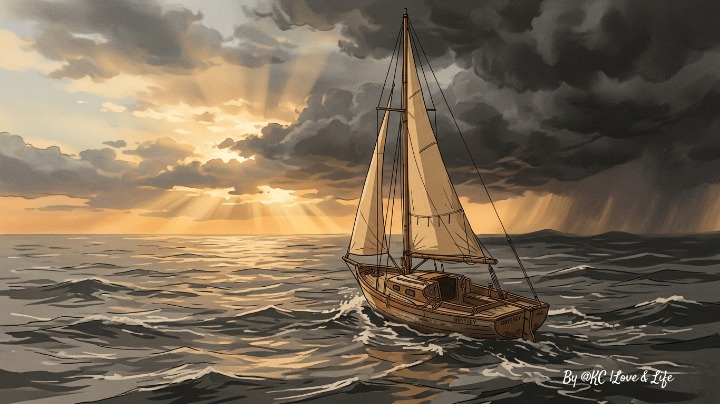
Imagine two ships sailing the same ocean, facing the same storm.
The first surrenders to it. Allows the winds to dictate its course, convinced that the weather determines the destination. It calls this fate — as if the storm itself gets to decide where the ship must go.
The second ship does something different. It can't control the weather. The waves are identical, the wind is identical, the conditions are exactly the same. But it adjusts its sails. It charts its own course through what it cannot change. It makes decisions instead of absorbing them.
The storm is the same. The ocean is the same. The only difference is in how each ship chooses to move through it.
You can't control what happened in your relationship. You can't control whether the love comes back or whether he changes. You can't control the fact that your heart is broken right now.
But you can control what you do next. And that — in the middle of something that feels entirely out of your hands — turns out to be everything.
What the Pain Is Actually Building
When I look back at that period of my life, I can see now that the healing happened across three areas — not all at once, not in any particular order, but all of them eventually, all of them necessary.
The first was emotional balance. Not the absence of pain — that's not balance, that's suppression. But the capacity to feel what I felt without being entirely defined by it. To grieve without collapsing. To sit with the loneliness and the uncertainty without immediately trying to fix it with someone new.
Healing isn't linear, and the setbacks aren't evidence that you're failing. They're evidence that what you lost actually mattered. Grief that moves in straight lines isn't grief — it's performance. Real grief spirals, and doubles back, and catches you off guard. And somewhere in that spiral, if you stay with it instead of running from it, something in you learns to hold it without being destroyed by it.
The second was coming home to my own femininity — and I don't mean this in a superficial sense. I mean reconnecting with the parts of myself I had slowly, quietly put aside. The softness I'd learned to armor over. The intuition I'd stopped trusting because I'd been wrong about him. I had gradually reshaped myself around what I thought he needed. Not dramatically — it happened in small increments, the way most self-abandonment does. A little less of my opinion here. A little more accommodation there. Until one day I looked up and realized I wasn't sure what I actually wanted anymore, separate from what I thought would keep things stable.
A woman who is disconnected from herself cannot recognize what is and isn't good for her. She's navigating without a compass. And no amount of external advice will substitute for that internal knowing — the quiet, steady sense of this is right or something here is wrong that only comes when you're actually inhabiting yourself.
The third was knowledge. This is the one I feel most deeply — and the one that gets skipped most often in conversations about healing.
Not inspiration. Not affirmations. Not the comfort of being told you're enough. But the kind of understanding that actually changes how you see. Why we choose who we choose. Why we stay when we know we should leave. Why some wounds keep showing up in new relationships, wearing different faces, until we address them at the source.
When I was in hospital — physically and emotionally depleted, with very little left — the first thing I invested in wasn't distraction or time. It was knowledge. I sold jewelry. I used what remained of my savings to enroll in courses on attachment, dating psychology, and healing. I studied eight to twelve hours a day for over two years. Because I had just lived through something I didn't have the language to understand, and I never wanted to be in that position again.
What I learned changed not just how I saw relationships, but how I saw myself. The patterns I'd been repeating weren't random. They were logical — given my history, given my wounds, given what I'd been taught love looked like. Understanding that didn't excuse anything. But it made everything navigable in a way it hadn't been before.
Comfort soothes the present moment. Knowledge protects the future. The women who stop repeating painful patterns aren't the ones who finally loved themselves enough — they're the ones who understood themselves deeply enough to make different choices.
What You're Actually Building
These three things work together in ways that matter. Emotional balance creates the steadiness to look honestly at yourself. Reconnecting with your femininity restores the internal compass that tells you what's true. And knowledge gives you the framework to understand what you're seeing. Remove any one of them, and the other two become harder to sustain.
The version of you on the other side of this isn't the same person who went in. She knows more. She's clearer about what she'll accept and what she won't — not as rules she's set for herself, but as things she understands too well to ignore. She trusts her instincts more, because she's learned what happens when she doesn't.
She's not harder. She's not closed. She's just built from something real now, rather than from hope alone.
You don't have to be grateful for what broke you. But you can decide what to do with what it left behind.
This is KC — from Love & Life. 💜