
The Truth, Without Kindness, Is Just Another Way of Hurting Someone
We were taught to be honest. We were also taught to choose our words carefully. Somewhere between those two lessons, a lot of people decided only the first one mattered — and called it integrity.
QUIET THOUGHTS
7/4/20263 min read
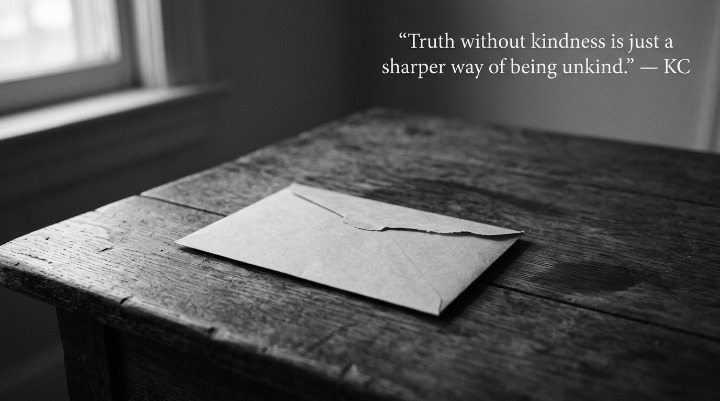
I stopped being close to one of my relatives — not because of any dramatic falling out, but because of the slow exhaustion of being around her.
She prided herself on being direct. And she was — in the way that left no room for anyone to breathe. She would say the most cutting things about people with the cheerful ease of someone commenting on the weather. When anyone pushed back, she had a line ready: the truth hurts, but medicine is bitter. She said it often enough that I think she genuinely believed frankness and harshness were the same thing.
But I kept coming back to a quieter question: does honesty have to feel like this? If you know something will land hard, doesn't that knowledge come with some responsibility for how you deliver it?
There is an old Vietnamese saying I grew up with that I think about more as I get older: lời nói chẳng mất tiền mua, lựa lời mà nói cho vừa lòng nhau. Words cost nothing — so choose them in a way that lands well.
It is not an instruction to be dishonest. It is not asking anyone to soften a truth into something false. It is simply pointing out what seems obvious when you say it plainly: the way something is said matters as much as what is being said.
We know this. Most of us feel it viscerally when someone gets it wrong. And yet there is a particular kind of person who has decided that caring about delivery is the same as being weak — that the only authentic version of honesty is the unfiltered one, consequences be damned.
I think about the way body commentary moves through everyday life — the remarks that arrive with no warning and leave lasting damage.
Dạo này em béo thế. You've put on weight lately.
Em gầy quá, ăn gì thế? You're so thin, what are you eating?
Said lightly. Said as observation. Said, often, with genuine affection — which somehow makes it worse, because it means the person didn't pause long enough to consider the weight of what they were delivering so casually.
I have watched women I care about receive these comments and visibly shrink. Not dramatically — just a small, almost imperceptible pulling inward. The kind of thing that doesn't show up in the moment but accumulates quietly over time, until one day they are standing in front of a mirror and hearing someone else's voice instead of their own.
That is what an unguarded truth can do. Not because it was false. Because it was real — and delivered without any thought for the person on the receiving end.
I am not arguing for dishonesty. I don't think people should say things they don't mean, or pretend problems don't exist, or wrap every difficult truth in so many layers of softness that the truth disappears entirely.
But I do believe this: truth without warmth is not really honesty in its fullest form. It is honesty stripped of the part that actually makes it useful — which is the intention to help the other person, not just to relieve yourself of the burden of knowing something.
The distance between blunt and kind is rarely as wide as people think. It is often just a few different words. A slightly different tone. A moment of asking yourself, before you speak: what am I actually trying to do here? Am I saying this because it will help them — or because I have decided my frankness is more important than their dignity?
That question changes things.
Sometimes people are not afraid of the truth itself. They are afraid of what the truth reveals about how they are being seen — whether the person saying it looks at them with care, or with judgment.
The same information lands completely differently depending on which one it comes wrapped in.
If you have something honest to say to someone — say it. But say it with all the kindness you can bring to it. Not because kindness makes the truth less true. Because it is the part that makes the truth actually land somewhere useful, rather than just somewhere painful.
We can always choose how we say things. That choice is not weakness. It is, I think, one of the more important ones we make.
This is KC — from Love & Life. 💜