The Art of Letting Go: Why the Hardest Part Isn't the Leaving
The hardest part of letting go isn't the leaving. It's giving yourself permission to want something different. Here's what I've learned — about the biology of why staying feels safer, the fear underneath all the other fears, and the one question that changes everything.
HEART TALK
KC
3/29/20268 min read
There's a particular kind of conversation that stays with you.
I was having coffee with a dear friend — the kind of woman who seems to have everything together from the outside. Brilliant, accomplished, the sort of person who builds businesses and raises children and somehow makes it all look effortless.
She looked up from her cup and said something that stopped me cold.
"I think I've known for two years that my marriage isn't working. But if I admit that out loud — what does that say about me?"
Her hands were shaking.
I recognized that shake. Not because I'd seen it in her before — but because I'd felt it in myself. That particular trembling that comes not from cold, but from the weight of a truth you've been holding alone for too long.
We talk about letting go as if it's a single moment. A decision. A door you walk through and close behind you. But that's not what I've seen — in my own life, or in the lives of the women I've walked alongside. Letting go is rarely a moment. It's a slow, private reckoning that happens long before anyone else knows it's happening.
And the hardest part isn't the leaving.
It's giving yourself permission to want something different.
The Prison Nobody Talks About
Here's something I wish someone had told me years ago.
The hardest prison to escape isn't built with locks and bars. It's built with time, and memories, and the accumulated weight of everything you've already invested.
Psychologists call it the sunk cost fallacy. I call it the "but I've already..." trap.
But I've already spent five years with him. But I've already built my life around this. But I've already told everyone this is my path.
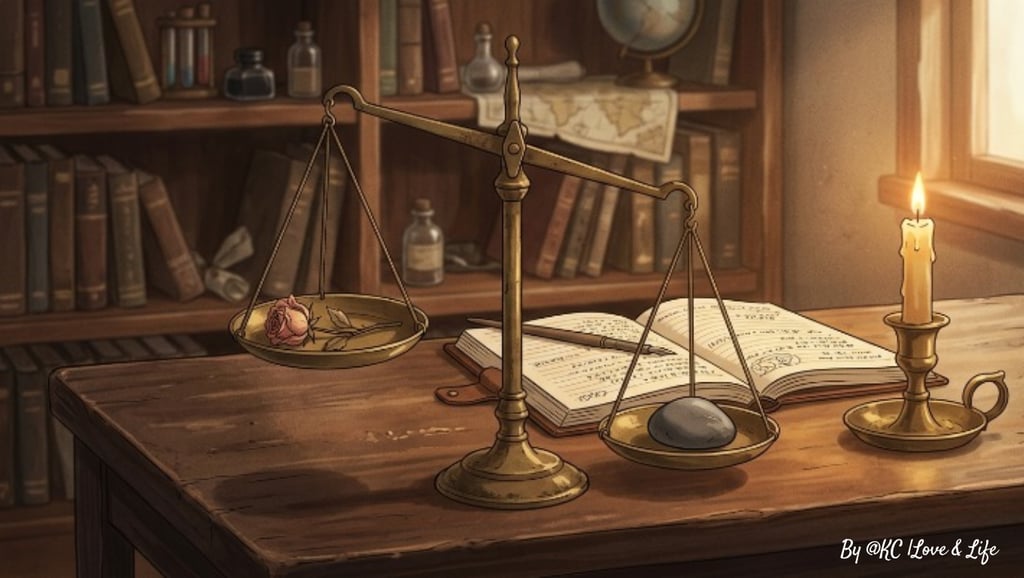
Think about what's actually happening in those sentences. You're not measuring the future against what you want. You're measuring it against what you've spent. And those are completely different calculations — one points toward your life, the other points toward your losses.
Here's the version that made it real for me: imagine you're reading a book that stopped engaging you halfway through. You might push yourself to finish it — you've already read 200 pages. But what if that book was making you actively miserable? What if every chapter left you feeling worse about yourself?
The pages you've already read don't justify the pages still to come.
This becomes so much more painful with relationships, because what you've invested isn't just time. It's youth. It's the version of yourself you shaped around another person. It's the future you built in your imagination — the one that felt so real you started treating it like something that already existed.
Choosing a different future doesn't erase that. Every experience has shaped who you are. The years mattered. The love was real, even when the relationship wasn't right.
But here is the question underneath all of it — the one worth sitting with honestly:
Is continuing on this path honoring who you're becoming? Or just protecting what you've already spent?
Those two things can feel identical from the inside. They're not.

💜 If this is where you are right now
Sometimes what we need most isn't more information — it's a framework for finally seeing clearly.
The Free Resource Library has the tools I wish I'd had during my own hardest seasons — including boundary-setting guides, reflection workbooks, and step-by-step frameworks for understanding what's actually keeping you stuck.
Why Your Brain Is Working Against You
Let me tell you why leaving feels so impossibly hard — even when every rational part of you knows staying is causing harm.
It's not weakness. It's not you being too emotional, too sensitive, too attached.
It's biology doing exactly what it was designed to do.
Our brains developed something called loss aversion as a survival mechanism. Research shows we feel the pain of losing something roughly twice as intensely as we feel the pleasure of gaining something equivalent. Finding money feels good. Losing the same amount feels devastating. Same number. Completely different emotional weight.
This is why leaving a relationship that's slowly draining you can feel scarier than staying lonely. Your brain isn't measuring your wellbeing — it's measuring what you stand to lose. And it treats emotional risk the same way it treats physical danger. The alarm bells fire either way.
But here's where your power is: understanding a pattern isn't the same as being controlled by it.
The alarm going off doesn't mean the danger is real. It means your brain is doing its job — the job it was designed to do in a very different kind of world, for a very different kind of threat. You can hear the alarm, recognize it for what it is, and still choose differently.
That's not easy. But it's available to you.
What Love Looks Like When It's Become a Weight
Back to my friend — her hands still shaking, her coffee going cold.
She told me how it had happened gradually. The loving partnership she'd once known had slowly become something else. Not through one dramatic rupture, but through accumulation — the way damage often works when it wants to go unnoticed.
The sighing when she tried to share her day. The hours on his phone, the ten minutes he couldn't find for bedtime. The casual comments about her weight, her cooking, her friends — each one small enough to dismiss, together impossible to ignore.
And through all of it, she kept thinking: If I just try harder. If I'm more patient. If I give him more time.
I know that thought. I've lived inside it.
What I told her that afternoon — and what I want to say to you now — is this:
Your happiness is not a luxury. It is not something you earn after you've tried hard enough, waited long enough, loved well enough. It is not the reward at the end of the sacrifice. It is the point.
A relationship that is slowly draining your life force isn't love in a difficult season. It's a cost you're paying indefinitely, with no return. And the longer you stay trying to fix something the other person isn't trying to fix with you, the more of yourself you spend on something that will never become what you need it to be.
She started crying then. Not sad tears.
Relief tears.
Because sometimes what we need most isn't advice or strategy or a five-step plan. It's simply permission. Permission to want more. Permission to say out loud that what is isn't enough. Permission to stop pretending, for just one moment, that everything is fine.
What You're Actually Afraid Of
When we say we're afraid of change, what we're usually afraid of is what change might reveal about us.
We're afraid we'll regret the decision. We're afraid we're giving up too easily. We're afraid there's nothing better waiting. We're afraid of being alone.
But underneath all of those fears, if you go deep enough, there's usually something quieter and more devastating:
If I couldn't make this work — what does that say about me?
My friend said it almost word for word. "If I leave, does that mean I'm a quitter? That I don't try hard enough? That I'm not lovable enough to make him want to stay?"
This is the fear that keeps more women in the wrong places than any other. Not fear of the unknown, not fear of being alone — but the fear that needing to leave is evidence of something fundamentally wrong with you.
It isn't.
Needing to leave a relationship that isn't working is not a character flaw. It's not failure. It's not giving up. It is — when it's honest, when it's finally clear — one of the most courageous forms of self-respect there is.
You are allowed to outgrow what once fit. You are allowed to want more than what you're being given. You are allowed to decide, at any point, that the life you're living isn't the life you want to keep living.
The relationship that worked when you were one version of yourself may not work for who you're becoming. The career that excited you at the start may feel suffocating now. The ways you learned to love — the patterns you absorbed, the things you accepted without question — may not be the ways you want to love anymore.
None of this means you failed.
It means you evolved. And evolution — real growth, the kind that costs something — always requires releasing what no longer serves the person you're in the process of becoming.
The Six-Month Question
I want to tell you what happened after that coffee.
I didn't tell my friend to leave. I didn't tell her to stay. What I offered her instead was a question — one I've come to believe is more useful than most advice:
What would you know, about yourself and about this relationship, if you spent the next six months paying honest attention instead of managing and hoping?
Not six months of trying harder. Not six months of ultimatums or strategies or waiting for him to change. Six months of clear-eyed, honest observation — of what is actually here, not what you wish were here. Of how you actually feel, not how you think you should feel.
Two weeks later, she made a decision. Not to leave immediately — but to stop pretending. To stop making excuses. To start paying attention to what was actually true.
That decision — just that one — changed everything for her.
Not because it gave her answers. But because it gave her back the one thing she'd quietly surrendered somewhere along the way: her own honest perception of her own life.
On the Other Side of This
Whatever you're holding right now — a relationship that's changed, a version of yourself you've outgrown, a truth you've been circling for longer than you want to admit — I want you to know something.
Your past isn't something to discard. Every experience has shaped you. The years you gave, the love you offered, the ways you showed up even when it cost you — those things are part of who you are. They don't disappear because the relationship does.
But they also don't have to determine what comes next.
Letting go isn't erasure. It's making space — for honesty, for clarity, for the version of your life that becomes possible when you stop pouring your energy into something that can't hold it.
Your intuition isn't wrong. That quiet voice that's been saying something isn't right here — it's been telling you the truth. It knew before your mind was ready to hear it. It's been waiting for you to trust it.
Trust it.
This is KC — from Love & Life. 💜