
The Art of Letting Go: Finding Joy in Life's Transitions
You know that feeling when you're stuck - in a relationship that's changed, a career that doesn't fit anymore, or a version of yourself you've outgrown? I've been there. And I've learned that the hardest part of letting go isn't the change itself - it's giving yourself permission to want something different. In this post, I'm sharing what I've learned about why we cling to what no longer serves us, the real fears underneath our resistance, and how to finally move forward with clarity.
HEALING & GROWTH 🌱THE SELF-LOVE SERIES 💖
KC
1/17/20257 min read
I was having coffee with a dear friend one afternoon when she looked up from her cup and said something that stopped me cold:
"I think I've known for two years that my marriage isn't working. But if I admit that out loud, what does that say about me?"
Her hands were shaking. This woman - brilliant, accomplished, the kind of person who builds businesses and raises kids and somehow makes it all look effortless - was terrified of what it might mean to finally tell the truth about what wasn't working.
Have you ever been there? Holding onto something - a relationship, a career path, maybe even a version of yourself - long past the point where you knew, deep down, it was time to let go?
If you have, I want you to know something: you're not weak for staying. You're human. And what you're experiencing isn't a character flaw. It's actually your brain doing exactly what it's wired to do.
Let me explain.
Why "But I've Already Invested So Much" Is Keeping You Stuck
Here's something I wish someone had told me years ago: the hardest prison to escape isn't built with locks and bars. It's built with time, memories, and the weight of everything you've already invested.
Psychologists call this the "sunk cost fallacy," but I call it the "but I've already..." trap:
"But I've already spent five years with him..."
"But I've already built my life around this job..."
"But I've already told everyone this is my path..."
Think about it. If you started reading a book that stopped engaging you halfway through, you might push yourself to finish just because you'd read 200 pages. But what if that book was making you actively miserable? What if every chapter left you feeling worse about yourself?
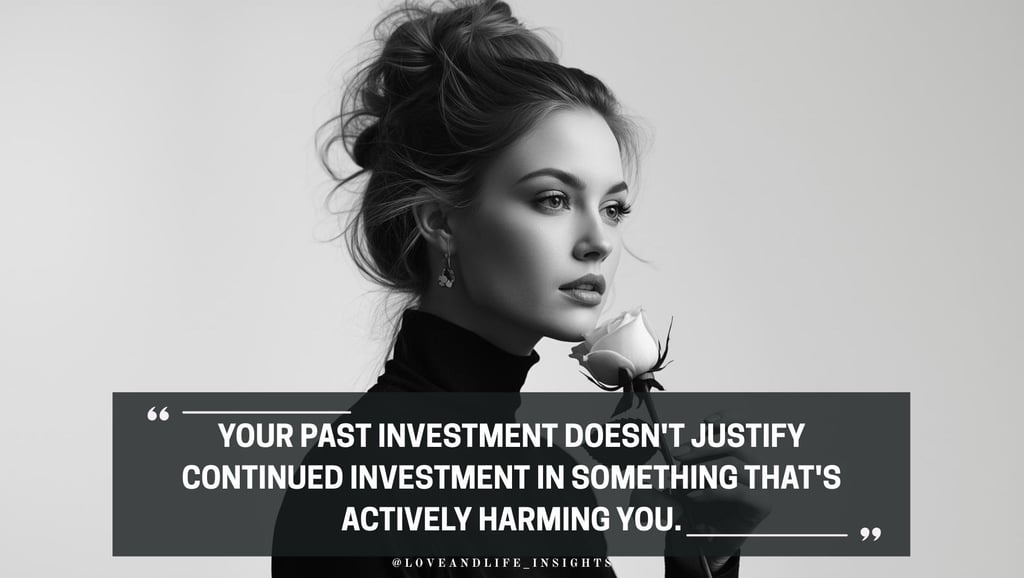
Your past investment doesn't justify continued investment in something that's actively harming you.
This becomes especially painful with relationships. The years shared, the memories created, the intertwined lives, the dreams you built together - all of it makes change feel like you're erasing your own history.
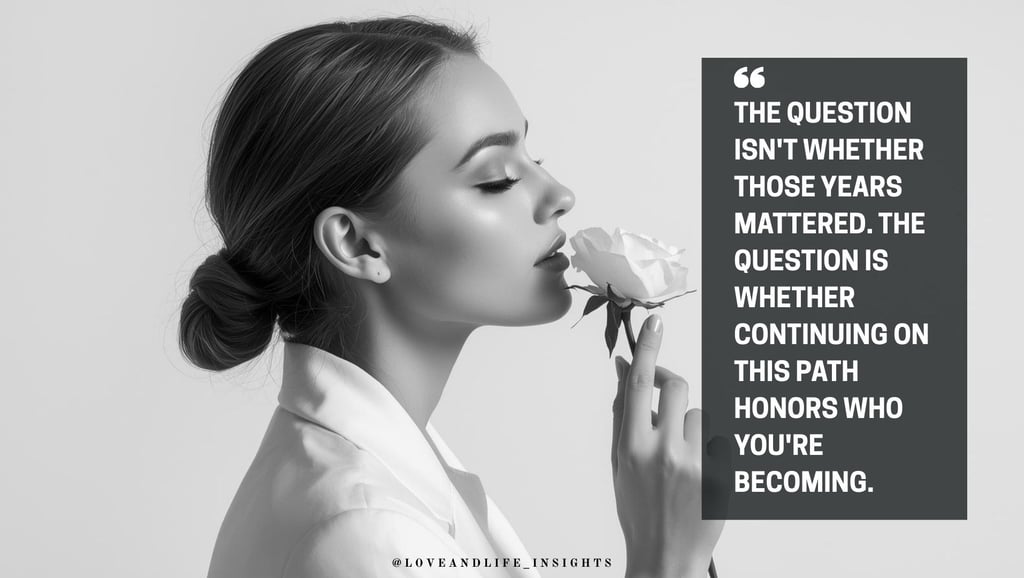
But choosing a different future doesn't invalidate your past. Every experience has shaped you. The question isn't whether those years mattered. The question is whether continuing on this path honors who you're becoming.
And sometimes - often, actually - the most loving thing we can do is recognize when it's time to walk away.


The Biology Behind Why Leaving Feels Impossible
Let's talk about why letting go feels so impossibly hard, even when every rational part of you knows staying is causing harm.
It's not weakness. It's not you being "too emotional." It's biology doing exactly what it's designed to do.
We're born with six basic emotions, and four of them - fear, disgust, anger, sadness - exist purely to protect us. Our brains developed something called "loss aversion" as a survival mechanism. Research shows we feel the pain of losing something roughly twice as intensely as we feel the pleasure of gaining something equivalent.
Finding $100 on the sidewalk feels good. Losing $100 from your wallet feels devastating. Same amount. Completely different emotional impact.
This is why leaving a mediocre relationship often feels scarier than staying lonely. Your brain is screaming "Don't lose what you have!" even when what you have is slowly destroying you.
Your brain can't always distinguish between physical danger and emotional risk. It treats both the same. So when you contemplate leaving, your nervous system fires up the same alarm bells it would if you were standing at the edge of a cliff.
But here's where your power lies: understanding this pattern isn't the same as being controlled by it. Some people - investors, entrepreneurs, people who've done deep personal work - have actually trained themselves to see possibilities where others only see risk.
You're not a prisoner of your biology. You're someone capable of recognizing these patterns and choosing differently anyway.


What Happens When Love Becomes a Weight
Back to my friend with her shaking hands and her coffee going cold.
She told me her marriage had slowly shifted from partnership to burden. Despite her incredible strength - managing a full-time career, building her own business, caring for their two kids - she found herself in a place where hope was colliding hard with reality.
The loving partnership she once knew had faded. In its place: distance, dismissiveness, the kind of disrespect that shows up in a thousand small ways. The way he'd sigh when she tried to share her day. How he'd spend hours scrolling his phone but couldn't find ten minutes to help with bedtime. The casual comments about her weight, her cooking, her friends.
And through it all, she kept thinking: If I just try harder. If I'm more understanding. If I give him more time to change.
Here's what I told her, and what I wish someone had said to me during my own difficult seasons:
"Your happiness isn't a luxury - it's essential. Yes, change is scary. But staying in a situation that's draining your life force? That costs you even more. What if we looked at this as a six-month intentional journey? Whether that leads to renewal or release, remember this: your children learn about love and self-worth by watching you. The greatest gift you can give them isn't a perfect family - it's showing them what healthy love and self-respect actually look like."
She started crying then. Not sad tears. Relief tears.
Because sometimes what we need most is permission to want more.
What You're Really Afraid Of
When we say we're afraid of change, what we're usually afraid of is ourselves.
We're afraid we'll regret the decision.
We're afraid we're giving up too easily.
We're afraid we won't find anything better.
We're afraid of being alone.
But underneath all those fears is something deeper: we're afraid that needing to leave proves something is wrong with us.
My friend said it perfectly: "If I can't make this work, what does that say about me? That I'm a quitter? That I don't try hard enough? That I'm not lovable enough to make him want to stay?"
Listen to me. You're human. You're allowed to outgrow what once fit. You're allowed to want more.
This is one of those serious mistakes women make when thinking about love - believing that needing to leave means we've failed.
The relationship that worked when you were 25 might not work when you're 35. The career that excited you fresh out of college might feel suffocating a decade later. The version of yourself you created to survive difficult years? She might not be who you need to be to thrive.
None of this means you failed. It means you evolved.
And evolution - true growth - requires letting go of what no longer serves the person you're becoming.
Your Past Doesn't Define Your Future
As we close our time together today, I want you to hold onto something: every experience in your life - even the painful ones - has shaped who you are, but they don't have to dictate who you become.
Whether you're questioning a relationship that no longer serves you, reconsidering your career path, or simply sensing it's time for change, trust that inner voice. Your intuition isn't wrong. It knows what you need, even when your fear tries to silence it.
Your transformation doesn't need a perfect roadmap. It needs your courage to take the first step.
And here's what I know: Your past isn't baggage to discard - it's the foundation that's prepared you for what's next. Every ending is also a journey from heartbreak to healing - a transformation that makes you stronger, more aligned with who you're meant to be.
The friend I told you about? Two weeks after our coffee conversation, she made a decision. Not to leave immediately, but to spend six months in intentional clarity. To stop pretending, stop making excuses, and start paying attention to what was actually true.
That honest assessment changed everything for her. It might change everything for you, too.
You're braver than you think. And you deserve a life that makes your heart feel alive.
This is KC - from Love & Life. ✨

💎Ready to choose yourself for 7 days?
If you're struggling to prioritize your own needs, the Self-Love Challenge is designed for you. It's a 7-day guided journey with daily prompts, affirmations, and micro-actions to help you rebuild your relationship with yourself - even when change feels scary.
💎Need more support as you navigate change?
I've created a free resource library with 8+ tools - workbooks, frameworks, and step-by-step guides - to help you set boundaries with confidence, recognize what you truly deserve, and rebuild your life on your own terms.